An agent that can only act alone either overreaches or gets stuck. Four tools let it involve someone else. They differ in one thing that decides which you want: whether the agent stays in charge of the work.
You add all four on the agent's Settings → Tools page with Add tool.
The agent hands the conversation over and steps out. Under Transfer to you pick Human agent or AI agent.
To route a transfer to a particular team or person:
Add the Transfer tool, or open the one the agent already has.
Set Transfer to to Human agent.
Under Assign ticket to, choose Nobody (leave unassigned), A specific team or A specific user, then pick the team or user.
Write the Context message: what the person needs to know about where things stand.
Save the tool.
Write the context message with care. It's what the person sees first, and a handover that only says "user needs help" wastes the work the agent already did.
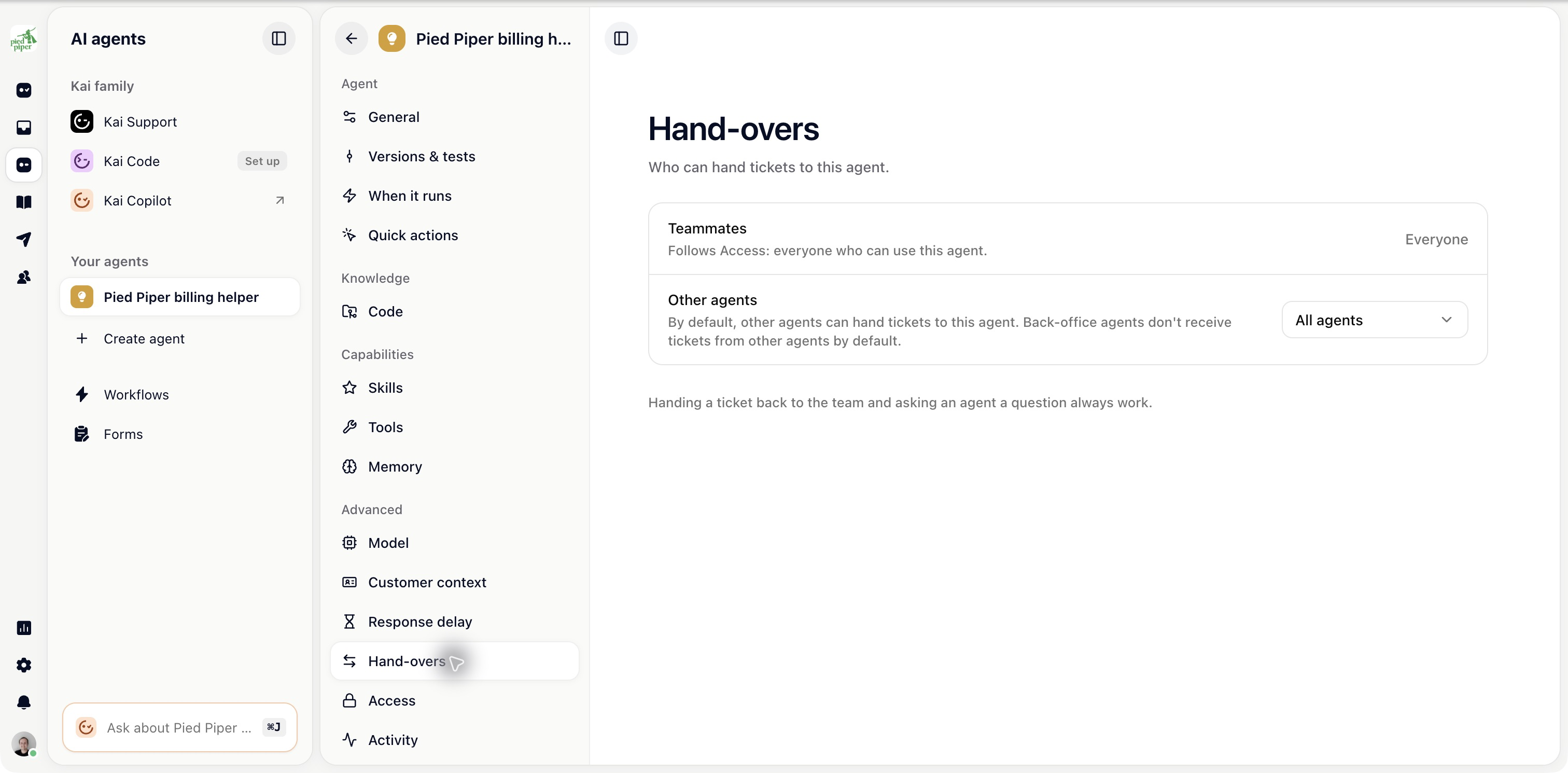
For AI agent, pick the Target agent. Only published agents that accept tickets from this one are listed. Each agent decides that on its own Handovers page, under Other agents.
The agent gives a task to another agent, waits, and carries on with the result. This is how you combine specialists instead of building one agent that does everything. A front-line agent that delegates order lookups to an orders agent stays simple, and the orders agent can be reused elsewhere.
There are two settings:
Delegate to agent (published). Only published agents can be picked.
Context mode. Task only sends just the instruction, which is cleaner and cheaper and the usual choice. Full conversation sends the whole thread, for tasks that can't be understood without it.
The agent stops and gives a teammate an open task: look something up, approve something, or do something it can't. It waits and continues with the answer. The tool has no settings. Once it's added, the agent decides when to ask and what to ask for, and the run shows as waiting for human input until a teammate answers.
Use it when the missing piece is knowledge or authority, not the whole task. The agent stays responsible for finishing.
The structured version. The teammate gets a decision card and picks between named options. Cards can have several steps with follow-up questions, for example "Add to roadmap / Implement / Drop", and on "Implement" a second question about the approach. Like Request human input, it has no settings.
Use it whenever the possible answers are known. "Refund in full, refund shipping only, or decline?" is answered in a second and gives the agent something clear to act on. The same question asked openly produces a paragraph it then has to interpret.
The agent shouldn't be doing this at all: Transfer.
Part of the job belongs to a specialist: Delegate.
It needs something only a person knows: Request human input.
It needs a person to choose between known options: Ask for a decision.