Kai Support's report shows how often it answers, how often conversations still reach your team and what customers think of its answers. Access and the records included depend on your reporting permissions and plan.
Click Reports in the sidebar.
Under AI agents, choose Kai Support.
Pick a date range at the top.
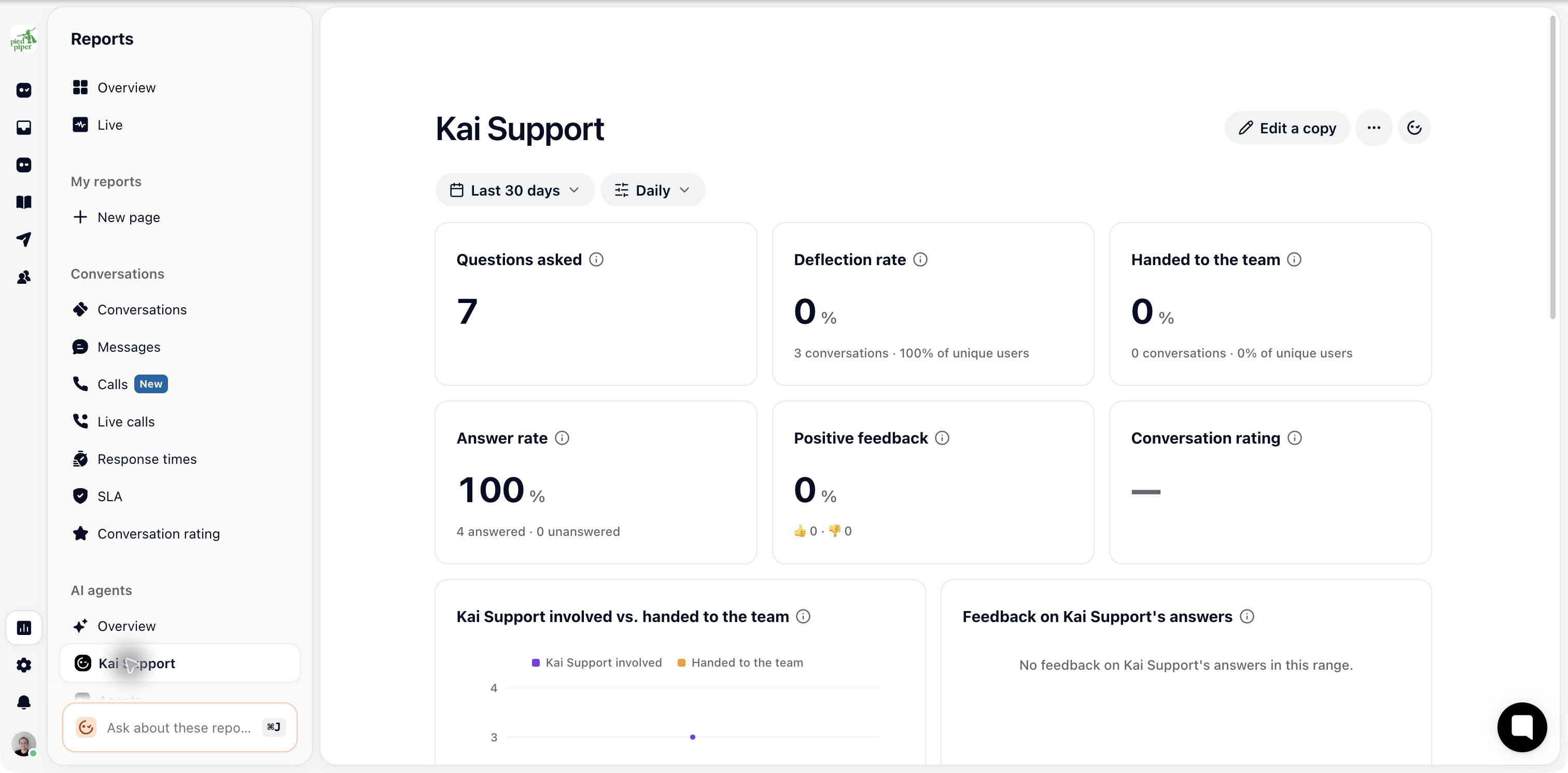
The page opens with six tiles: Questions asked, Deflection rate, Handed to the team, Answer rate, Positive feedback and Conversation rating. Charts of Kai's conversations and feedback follow, and the page ends with Latest negative feedback.

Of the conversations Kai Support took part in, the share that never turned into a request for a person. If Kai was involved in 100 conversations and 20 of them ended up asking for support, deflection is 80%. Higher is better.
Its counterpart, Handed to the team, looks at the same conversations from the other side: how often one did end up with a teammate. Lower is better. Both tiles also show the plain count, which is easier to check against your inbox.
Under each of these two rates, the tile also shows the share of unique users. The main rate counts conversations. The unique-users share counts people, so someone who came back five times counts once. If the conversation rate looks healthy but the unique-users share is clearly worse, a small group keeps coming back without getting what they need.
Answer rate is the share of questions Kai Support could answer, with the answered and unanswered counts underneath. The unanswered count is the more useful one. It measures the gaps in your content, and it goes down when you write, not when you change settings.
Questions asked tells you whether people use Kai at all. A low number points to placement, not quality.
Where customers may rate an answer, Positive feedback shows the share of thumbs up, with both counts underneath, and the charts show feedback over time. Conversation rating shows how customers rated the conversations Kai Support handled.
Latest negative feedback lists the most recent answers that got a thumbs down. It's the most useful part of the page: each entry is a real question where the answer missed, and a better guide to what to write next than any average. Fix a wrong answer shows what to do with it.
Deflection on its own is a misleading target. A customer who gives up and closes the window counts as deflected, just like one who got a good answer, because neither asked for a person. Make it hard to reach a person and deflection goes up while your support gets worse.
Read it alongside Positive feedback and the unanswered count. Deflection rising while ratings hold steady is real progress. Deflection rising while ratings fall means people are giving up.